
By erecting thirty thousand dams of significant size across the American West, they dewatered countless rivers, wiped out millions of acres of riparian habitat, shut off many thousands of river miles of salmon habitat, silted over spawning beds, poisoned return flows with agricultural chemicals, set the plague of livestock loose on the arid land--in a nutshell they made it close to impossible for numerous native species to survive. ― Marc Reisner, 1986
The destructive dewatering that Marc Reisner described for the American West nearly 40 years ago has now gone thoroughly global. The victims are literally untold inhabitants of the living world. This essay is companion to The Great Land Heist. Together they characterize the immense scale of civilization’s unjust expropriation of the two great essentials for terrestrial life—habitable land and freshwater.
Dams and Reservoirs
Believe it or not, nobody knows how many dams there are in the world! Records exist for over 62,000 large dams, namely those that impound more than 3 million cubic meters of water. Smaller dams are thought to number in the many millions. Over the past 60 years, the number of dams has likely increased at least sixfold. Today, dam construction is rapidly accelerating across tropical regions of the world.
Dams are designed to tame rivers and streams for a host of advantages over nature, including water capture for crop irrigation, livestock, municipal use, hydro-power generation, fish “farming,” recreation, and flood control. They allow people to further colonize and more intensively exploit nearby lands, expand industrialization, and ultimately increase their numbers.
As of 2019, less than a quarter of the world’s rivers longer than 600 miles flowed to the sea unobstructed by dams. These are mainly found in less habitable regions of low human density like the Arctic, the Amazon, and the Congo basin.
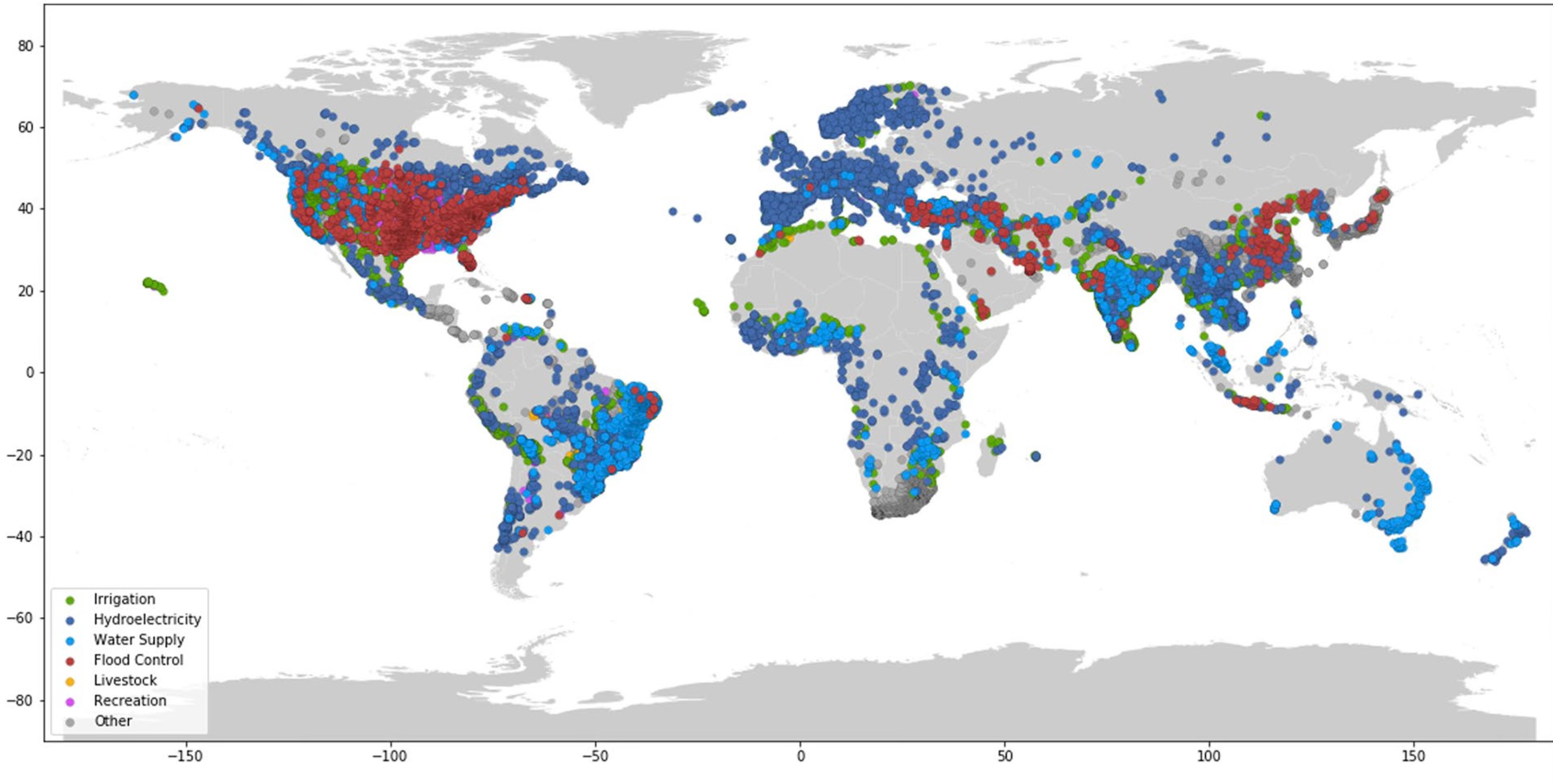

Dams have tremendous consequences for both aquatic and terrestrial life, most obviously fishes, but also for vast numbers of other living beings.
Here’s a short list of how dams can adversely affect wildlife and river ecology (for a good technical overview read this).
Dams harm life by:
Obstructing fish movements, migrations, and access to spawning areas; in short, limiting habitat use by fish and fragmenting their populations.
Reducing fish numbers and indirectly other wildlife that prey upon fish. Hydroelectric dams directly kill fish that are sucked into turbines or slammed against structures.
Increasing mortality and morbidity of fish and other aquatic life by lowering oxygen levels of impounded waters and downstream. Water released from dam turbines and spillways usually flows from deep areas in reservoirs with little or no oxygen.
Changing water temperature (as well as oxygen levels) and creating stagnant water in reservoirs that trigger overgrowth of algae, fish parasites, less ecologically desirable plants, and non-native organisms.
Impeding nutrient and sediment flow critical for replenishing downstream riverbeds, deltas, floodplains, and estuaries.
Increasing deforestation and other terrestrial habitat loss through flooding and dam-related construction of roads and supporting infrastructure.
Releasing methane, a potent greenhouse gas, as submerged forests and other organic matter decomposes anaerobically in reservoir water.
Trapping toxic substances like heavy metals, pesticides, and microplastics.
Causing ecological “shock waves” with flow interruptions and rapid fluctuations in water discharge downstream of dams.
It’s truly mind boggling as to how many forms of life are impacted by dams. No one knows the full extent of this, but certainly it’s in the many thousands if not millions.
Take, for example, this statement on migratory fish from International Rivers:
Worldwide, large-scale dams have blocked fish migration paths and altered conditions in many major tributaries, including the Mekong, Snake, and Xingu Rivers. A 2024 update to the Living Planet Index for Migratory Freshwater Species showed that between 1970 and 2020, migratory freshwater fish populations declined by an average 81%.
Words can’t convey what a heartbreak this is. If you love life and have snorkeled with fishes and other aquatic life, you know exactly what I mean. Some estimates indicate that a third of freshwater fish are at risk of extinction from hydropower dam expansion alone.
The damn dams (in combination with other human effects) harm a wide range of other living beings, including off-shore marine fish, many kinds of freshwater mussels, other invertebrates, people (some), dolphins, other mammals, and birds.
A civilization that builds vast numbers of dams is morally vacuous, if not insane.
Wetland Destruction
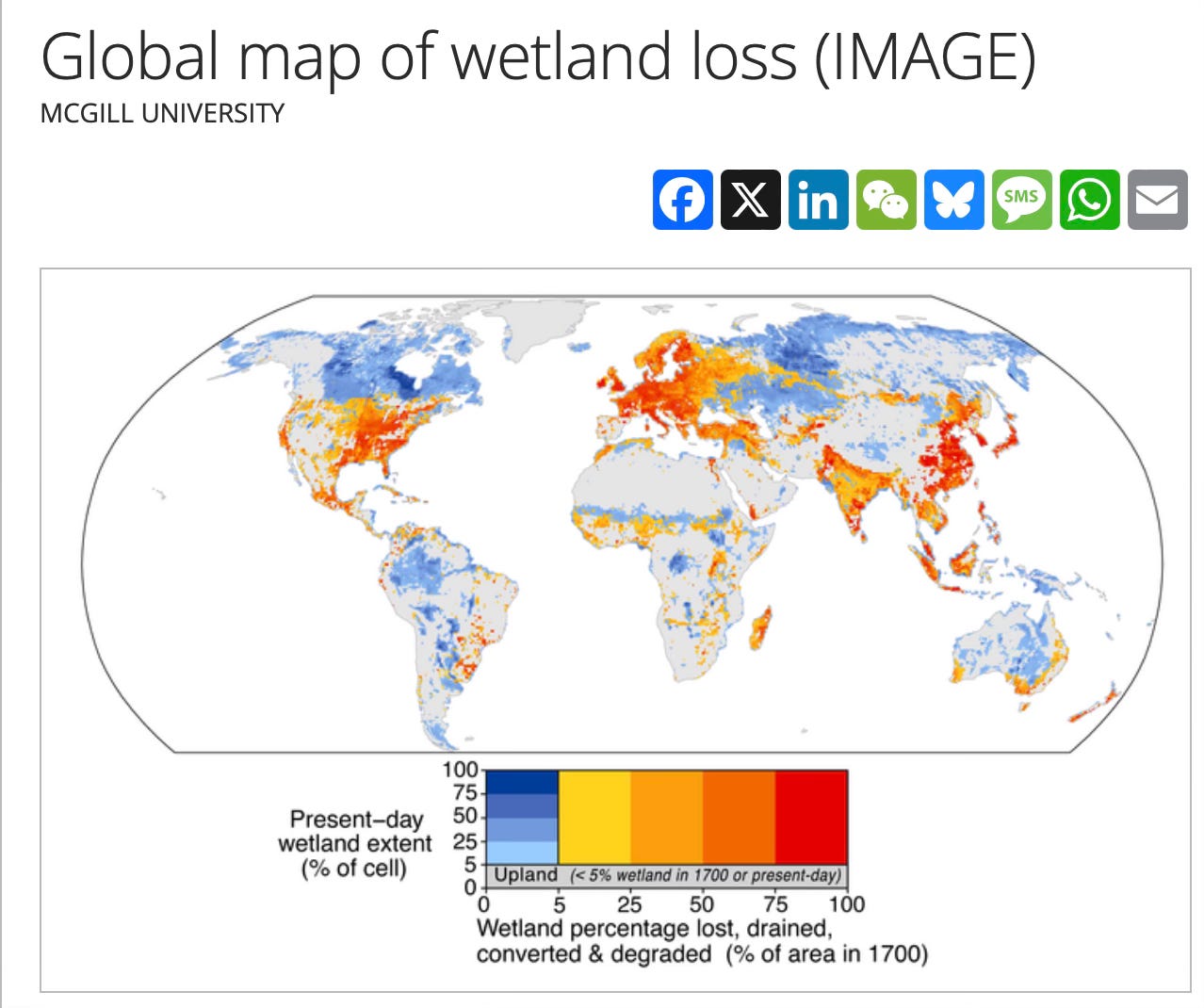
It’s no simple task to determine how many of the world’s wetlands have been disappeared or degraded by humans. The Global Wetland Outlook reports that:
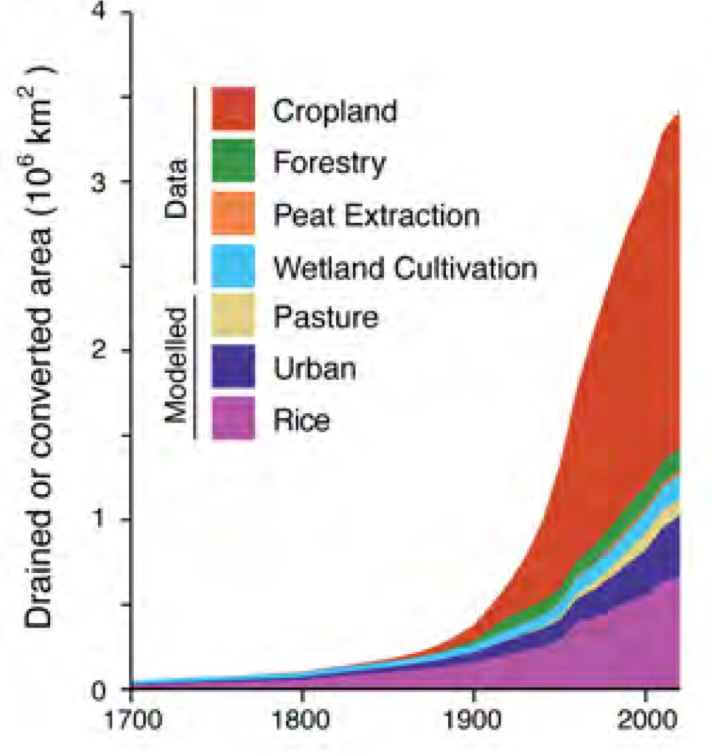
Since 1970, an estimated 411 million hectares of wetlands — approximately 22% of the global total — have been lost, with an ongoing annual decline of 0.52%. Degradation now rivals outright loss. Around 25% of the remaining wetlands are in poor ecological condition, and this proportion is increasing in all regions.
A primary driver of wetland loss is expropriation to produce food to feed billions of people. In short, “agricultural development has been the main proximate cause of wetland conversion, and economic growth and population density are the most frequently identified underlying forces.”
The victims of wetland destruction are innumerable. Just imagine how many fish, amphibians, reptiles, birds, mammals, invertebrates, plants, and other life have been, directly or indirectly, eliminated. Wetlands are believed to support about 40% of the world’s plant and animal species. In the U.S. alone, about half of all endangered species depend on wetlands.
Water Pollution and Climate Disruption
The act of polluting water, while not literally a theft, is ecological robbery nonetheless. So are rapid perturbations of water levels and quality forced by human-caused climate disruption. Many journals, books, and technical reports cover these matters in detail. For now, just take note that there’s more to theft than outright robbery.
Desalination
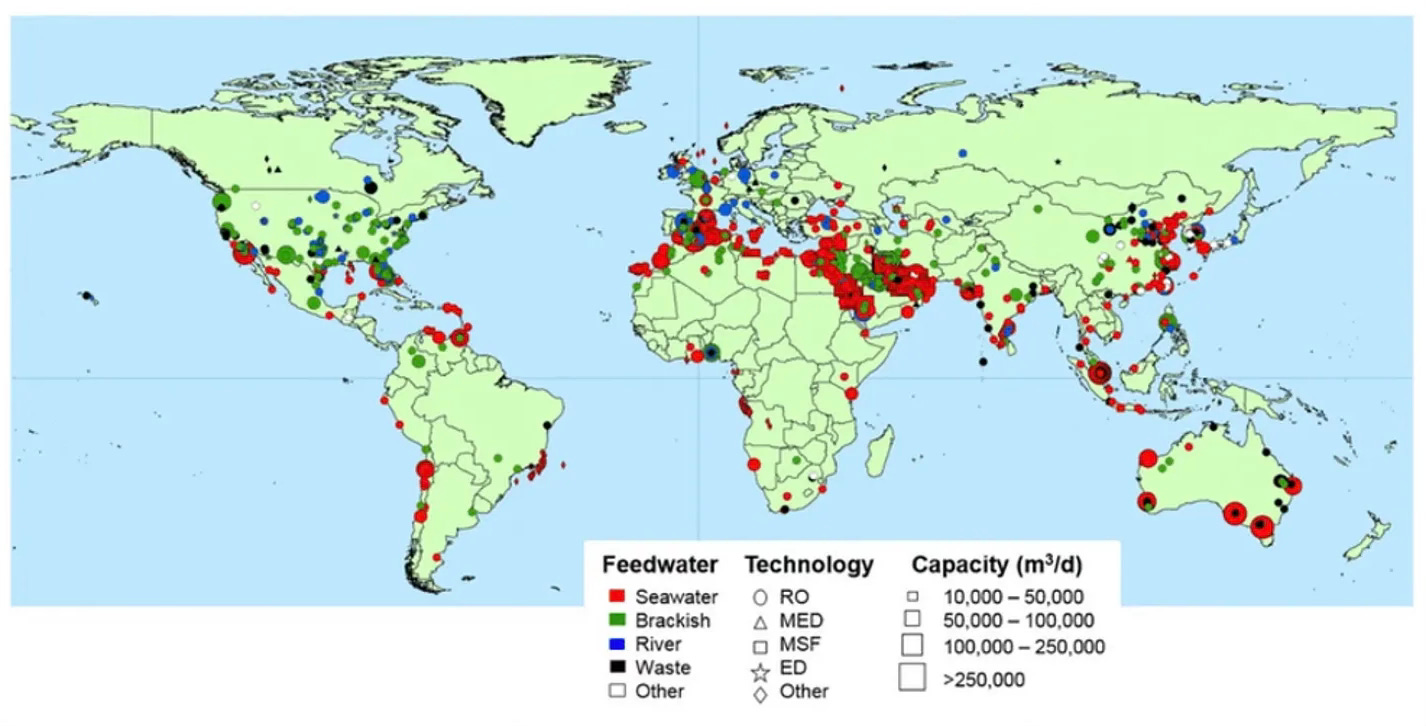
If mass thievery of fresh water were not enough, our civilization seeks more water for excessive economic growth and colonization of land through water desalination—at additional harm to oceanic and terrestrial life.
The process of desalination traps and kills aquatic life at the point of plant intake. It also creates toxic brine (a sludge of salt and processing chemicals) that’s either released into the ocean, into surface waters, “stored” in some way on land, or injected underground. Concerns are detailed here, here, and here.
❖
Let’s face it, modern humans are a selfish mob whether by culture, capitalism, technology, or fate. Given the vast scale of our thievery, those of us troubled by this might be tempted to throw up our hands and conclude there’s little hope for the living world unless humanity collapses. Count me out on that.
We have an intrinsic ability to make moral choices. Therein lies our salvation—and that of most other life on Earth.
But there are serious obstacles. By and large, our culture insists that non-human life has no moral status. This belief is a vehicle of convenience intended to absolve humans of wrongdoing toward other life.
The notion that morality is somehow restricted to an anthropocentric pimple in space-time is nothing more than self-serving nonsense. No intelligent life visiting from beyond Earth would honor that.
In short, there is no moral justification for expropriating for ourselves—one species out of 10 million—the world’s accessible freshwater and land. There’s no need even to assign moral standing to other-than-human life. It already exists if we care to acknowledge it (see below). Fortunately, there is hope to be found in the rapidly evolving Rights of Nature movement.
There are now about 500 “nature rights” initiatives across 40 countries, and a growing global network of like-minded people. A one-page graphic summary of the movement can be found here.
❖
There is natural law that’s applicable to all life. It is obscure to most of us but discoverable through reason and the capacity to distinguish right from wrong. Much broader than that long acknowledged for people, such law is grounded in a universal moral principle derived from Nature independent of human-made rules.
We cannot be certain how widespread morality is among living organisms, but its occurrence signals natural law that gives all beings an inalienable right to pursue life, liberty, and fulfillment, collectively if not individually. Derived from it, rights for nature must now be quickly elaborated, adopted, and honored.
❖
The massive scale of humanity today makes it impossible to undo its vast harm to the living world. Restoring nature, rewilding, or creating a nature-positive society are wonderful endeavors but unachievable in the broad sense of these terms. The enormous overgrowth of our civilization has rendered most harms to life unmitigable.
This problem of scale merits a fundamental shift in how we think, behave, and live. It demands that we bring our actions into alignment with biocentric values and external reality.
Grasp all, lose all - Ancient proverb.
Dear Readers,
Kindly subscribe if you haven’t already. And please share Scale Down with family and friends. We’re in this movement together. Thank you!
For the living world,
Tony P.
Phenomenal research and write up, and a philosophically hopeful end. I do hope people come to their senses about our collective impacts. The mainstream western economic system doesn't even value nature, much less give it rights. Only people can change this, and you are making that case from multiple angles repeatedly which should help people move in the right direction to reduce their impacts. It is people who make laws that can give rights to nature. It is people that make policies to incentivize conservation or not. It is consumers that can slow the run away train of overexploitation of nature simply by having fewer children and consuming less stuff beyond their basic needs. Keep up your valiant effort!